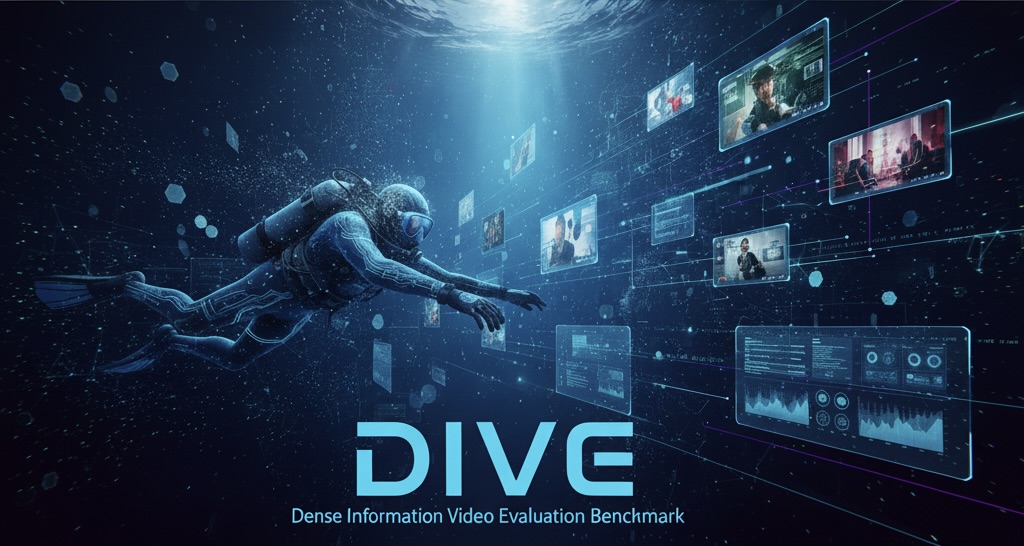
DIVE-Bench tests video-language models when evidence is not confined to a few keyframes—from long-form educational content to precise high-motion trajectories.
Haichao Zhang1, Wenhao Chai2, Shwai He3, Ang Li3, Yun Fu1
1Northeastern University 2Princeton University 3University of Maryland
00:0032:14
OCR
diagram
subtitle
motion
detail
Dense evidence requires temporal coverage→GRT reuses what stays static
317educational source videos
634educational QA items
1,000high-motion preview items
—evaluated LPM methods
01 / Benchmark
Two tracks. One missing capability.
Most video benchmarks reward sparse glimpses. DIVE-Bench isolates the harder case: details accumulate over long timelines, or change faster than sparse sampling can preserve.
A
Educational High-FPS Videos · LPM
Read and reason across educational video.
Questions target visible text and subtitles distributed across educational videos. The released, gated split contains 634 evaluation items, with two prompts per source video. This evaluation uses video frames, not an audio-input protocol.
OCR
Subtitles
Long-form
Open-ended QA
Primary rankingOpen MOS ↑
B
High-Motion High-FPS Videos · v2 preview
Track fine motion at frame-level precision.
Models predict a hand trajectory over a semantic 3×3 image grid. The corrected v2 reference uses the right-hand ring-finger metacarpal as a named palm proxy, with invalid reference positions masked. Published results cover the fixed first 1,000 source records, not the full 3,243-item test split. Source media remain separately authorized and are not bundled with the code.
Trajectory
3×3 grid
Transitions
High FPS
Primary rankingGrid Accuracy ↑
Figure 1. DIVE-Bench couples information-dense evaluation with a token-efficient model pathway. Source: project paper.
02 / Method
Spend computation on what changed.
Gated Residual Tokenization (GRT) treats video more like a codec: preserve a full visual reference, then selectively recompute residual content while consolidating repeated scene semantics.
01
Dense frames
High temporal coverage
motion cues
02
Inter-token gate
Reuse static regions; recompute residual change
residual tokens
03
Scene merge
Consolidate semantically redundant tokens
compact context
04
Video LLM
Answer with temporally dense evidence
Inter-tokenization
Motion-aware gating reuses selected patch projections for visual regions that remain stable from frame to frame.
Intra-tokenization
Semantic-scene merging reduces redundant context after visual encoding while retaining dynamic evidence.
Measured efficiency
Recompute ratio measures patch-projection reuse; sampling density (fps) is sampled frames divided by source duration, not end-to-end throughput.
03 / Leaderboard
Complete protocol-screened leaderboard.
Switch tracks, search models, filter sources, and sort any metric. A dash means unreported or undefined under the valid-reference mask, never zero. High-Motion v2 shows metric-specific coverage; Educational methods without Open MOS sort after scored methods, then by Token F1.
Educational historical snapshot20 Aug 2026
29 Educational results, 19 High-Motion v2 preview results and 12 educational GRT comparison rows (60 CSV records), audited 15 September 2026.Full HTML tables (no JavaScript) · Download CSV · Comparison evidence. Educational scores are not a fresh GPU rerun. High-Motion compares one new GRT run with 18 CPU-rescored archived baselines; baseline inference was not repeated. Missing values are not zero; no score is imputed.
Four-family Educational GRT qualification
—
Educational GRT: does it beat the baselines?
All three promoted educational profiles exceed their archived and matched controls on Open MOS and Token F1 while recomputing fewer patch projections. This is a point-estimate result, not a significance claim or a win on every metric. The larger gap to archived Qwen baselines includes protocol differences and must not be attributed entirely to gating.
634 educational items per method, eight sampled frames; all controls shown
Family / control
Open MOS ↑
Token F1 ↑
Patch recompute ↓
Mean throughput (fps) ↑
Mean request time (s) ↓
Qwen 3B GRT is slower than its matched all-patch control on the reported mean throughput (1.673 vs 1.750 fps), despite better quality and lower patch compute. Timing is historical per-request telemetry, not repeated end-to-end speed benchmarking. Eight sampled frames do not establish high-FPS coverage; patch reuse is not end-to-end FLOPs. Inspect exact values and all control rows.
High-Motion v2: corrected references, mixed metric outcomes. On the fixed 1,000-record preview, GRT exceeds its corresponding HF 0.5B baseline on observed Grid Accuracy, with improved Grid ADE, Grid FDE and Token F1; Transition Accuracy regresses. All five exact differences remain visible. Both sides use the same corrected reference mask and unchanged questions. The right-ring metacarpal is an explicit palm proxy; valid projection is not proof of RGB visibility. This is not a full 3,243-record evaluation or a statistical-significance claim. Exact historical baseline weight revisions and consumed-tensor identity remain unproven.
There is no hidden composite score. Each track exposes its task metric and supporting quality or efficiency measures.
Result provenance. The immutable historical snapshot was generated from 21 evaluation artifacts on 20 August 2026. Educational Open MOS uses Qwen/Qwen3-VL-32B-Instruct as the open text judge. Public score audit · Educational reproduction protocol. Frozen score bytes remain available in the original snapshot; corrected High-Motion v2 uses its separate dated evidence bundle.
04 / Reproduce
Public code. Explicit reproduction limits.
The minimal code and numerical evidence support an offline rebuild of 29 Educational results, 19 corrected High-Motion preview results and 12 educational GRT comparison rows. The original 32-row snapshot remains unchanged as historical evidence. Reaggregating saved numeric evidence does not rerun models. Fresh inference requires appropriate GPU resources and separately authorized source data; private source videos, HDF5 files and derived annotations are not bundled or licensed for redistribution by this code release.
setup.sh
git clone --branch main --single-branch \
  https://github.com/Hai-chao-Zhang/DenseVideoUnderstand.git DIVE-Bench
cd DIVE-Bench
python -m pip install 'PyYAML>=6'
# 29 Educational + 19 High-Motion preview + 12 comparison rows (60 CSV records).
# Pinned v2 manifest: 1f64ff54ec8eb09d72c37d6ef3a944e8ccae0a58fe5b4d45fabdfb0a7449d0dc
python -m tools.densevideo.build_complete_leaderboard --verify-only
python -m tools.densevideo.build_complete_leaderboard --output outputs/leaderboard-complete
# Open outputs/leaderboard-complete/leaderboard.html; output must be new.
Protocol notes
01 Use a dedicated environment; minimal DIVE-Bench and upstream lmms-eval share a Python namespace.
02 Keep the 1,000-item preview separate from the full 3,243-item task and from different API protocols.
03 Record model/data revisions, frame budgets, predictions, quality gates and request telemetry.
Framework submissions VLMEvalKit #1686 and lmms-eval #1521 are submitted Draft PRs, not upstream acceptance. Data permissions and manuscript/protocol differences remain documented in the public audit.
05 / Cite
Build on DIVE-Bench.
If the benchmark or GRT is useful in your research, please cite the project paper. The citation below identifies the earlier educational-scope arXiv version; the bundled revised manuscript covers both tasks.
@article{zhang2025dive,
  title   = {Dense Video Understanding with
             Gated Residual Tokenization},
  author  = {Zhang, Haichao and Chai, Wenhao and
             He, Shwai and Li, Ang and Fu, Yun},
  journal = {arXiv preprint arXiv:2509.14199},
  year    = {2025}
}